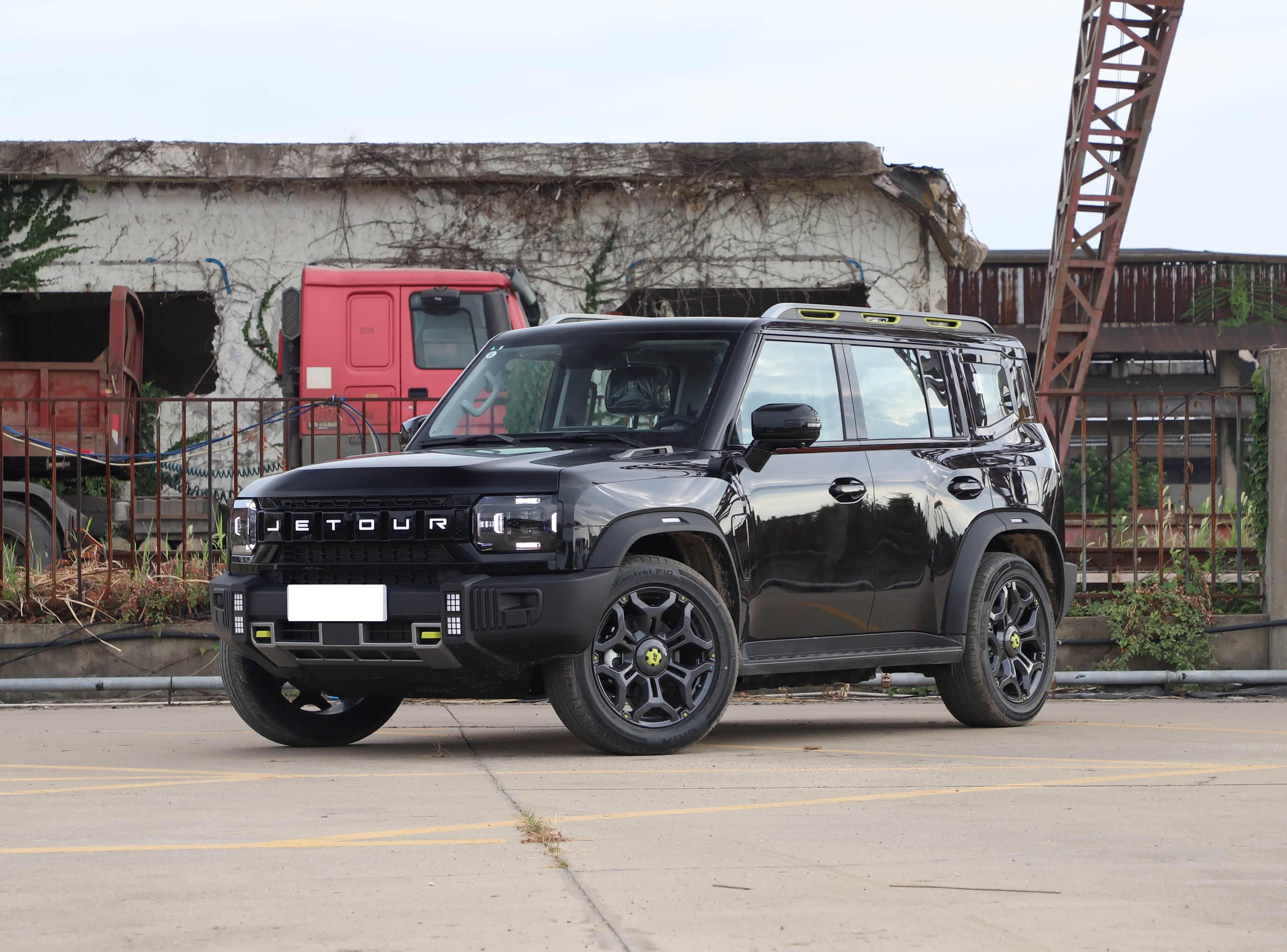
A dealer in Lagos phoned us a few months back with a question we hear fairly often: "My customers keep asking about Jetour. Is this thing real, or just another cheap Chinese brand that will break down in six months?"
Fair question. The Chinese car industry has a complicated reputation outside its home market - and honestly, some of that reputation was earned the hard way in the early 2000s. But Jetour in 2026 is a different story, and the sales numbers are getting hard to ignore. January 2026 alone: 23,717 units shipped overseas. That is not a niche brand quietly testing foreign waters. That is a full-scale global rollout.
So let us get into it: what is Jetour, where did it come from, and why are dealers from Nairobi to Riyadh suddenly making room for it on their lots?
Jetour Is Not "Just Chery in Disguise"
The first thing to clarify: Jetour is a sub-brand of Chery Holding Group, China's largest privately-owned car manufacturer. But calling Jetour "just Chery" is like calling Lexus "just Toyota." The DNA is shared, but the product strategy is different.
Chery founded Jetour in 2018 with a specific brief: build lifestyle-oriented family SUVs for people who travel - not just commute. The "Travel+" philosophy shows up in the product design: panoramic roofs, generous ground clearance, multi-row seating configurations, and chassis tuning aimed at mixed on/off-road use. The name itself is a contraction of "journey" - which, corny as it sounds, does describe the target buyer pretty accurately.
Today Jetour operates under three distinct sub-lines:
| Sub-Brand | Focus | Key Models |
|---|---|---|
| Jetour (Mainstream) | Family SUVs for global middle-class buyers | X70 Plus, X70L, Dashing |
| Shanhai (山海) | PHEV hybrid off-road SUVs | T1, T2, T2 C-DM |
| Zongheng (纵横) | Luxury off-road and pickup | G700 |
That three-tier structure matters for dealers. It means Jetour can cover a surprisingly wide price band - from a practical family hauler at under $22,000 FOB to a luxury off-roader at $26,500+ - without the product lines undercutting each other.
Where Is Jetour Actually Selling?
Officially: 67 countries, with active dealership networks in most. That number gets cited a lot in press releases, but what is more useful for a wholesale dealer is the regional breakdown.
| Region | Current Presence | 2026 Growth Signal |
|---|---|---|
| Middle East (UAE, Saudi, Kuwait) | Active distributors, 8.45% market share UAE | T2 gaining ground on Haval and MG |
| Africa (Nigeria, Kenya, South Africa) | Established importers in Lagos and Nairobi | Price-competitiveness driving fleet sales |
| Eastern Europe (Poland, Czech, Hungary) | T2 C-DM deliveries began Q1 2026 | Alan Walker brand partnership amplifying reach |
| Latin America (Mexico, Chile) | New HQ opened in Mexico City, 2025 | Targeting urban family SUV segment |
| Southeast Asia (Thailand, Philippines) | Distributor agreements in place | Hybrid models competitive vs. Japanese |
What Makes Jetour Different from Other Chinese Exports?
The honest answer: build quality consistency and warranty backing. Two things that sank earlier Chinese export brands were inconsistent assembly quality and no meaningful after-sales support once the cars left port. Jetour has addressed both, at least partially.
The 8-year / 1,000,000 km powertrain warranty on select models is not window dressing - it reflects the company's calculation that they will lose less money on warranty claims than on brand reputation damage. The ASEAN NCAP 5-star safety rating on the T2 gives dealers in markets where safety certification matters a concrete selling point.
That said, there is a realistic caveat: spare parts availability outside of established Jetour markets is still patchy. A dealer in a country without a local Chery/Jetour parts warehouse will have longer turnaround times on repairs. For fleet buyers and dealers in such markets, this is a genuine consideration - not a dealbreaker, but worth planning for.
The Hybrid Question: Is Jetour "Electric" or Not?
Technically, Jetour's flagship models (the Shanhai T series) use plug-in hybrid (PHEV) technology, not pure EV. The C-DM (Chery Drive Module) system in the T2 pairs a 1.5T turbocharged engine with an electric motor, delivering roughly 430 km of combined range and around 150 km of pure electric driving. For most export markets - where EV charging infrastructure is still developing - this is actually the right call.
The T1 uses a similar PHEV setup, while the mainstream X70 Plus remains a conventional 1.5T turbocharged gasoline model. The Zongheng G700 is a diesel-leaning pickup-style SUV with traditional powertrain options.
Q: Is Jetour a reliable car brand for export markets?
A: Based on 2025-2026 market data, Jetour has demonstrated solid reliability for its class and price point. The brand holds a 5-star ASEAN NCAP safety rating (T2 model), offers an 8-year/1,000,000 km powertrain warranty, and is backed by Chery Holding Group's 20+ years of manufacturing experience. For dealers in markets where Jetour has established parts distribution, customer satisfaction rates have been competitive with Japanese equivalents in the same price bracket. Markets without local parts networks face longer service turnaround times.
Why Are Dealers Choosing Jetour Now?
Three converging factors:
Price-to-spec ratio. At $21,800-$26,500 FOB Shanghai, you are getting a 7-seat family SUV with panoramic glass, dual-screen infotainment, and PHEV options. Finding equivalent features in a Toyota or Hyundai at that price is basically impossible in 2026.
Timing. Jetour reached this quality level right as buyers in Africa and the Middle East started actively looking for Japanese-quality alternatives at Chinese prices. That window may narrow as competition increases, but right now the brand is early enough that first-movers still get exclusivity in sub-markets.
Export infrastructure. Unlike smaller Chinese brands that ship cars and walk away, Jetour's export network - backed by Chery's global footprint - means port inspection support, export documentation, and basic after-sales coordination through authorized channels. Not perfect, but materially better than five years ago.
What Jetour Still Needs to Prove
Honest assessment: brand recognition outside of China and a few early markets is still modest. Ask a car buyer in Accra or Amman to name three Jetour models and most will not get past one. The brand is building recognition, but it has not made the leap to household name yet in most export markets.
Long-term reliability data beyond 100,000 km is also still accumulating. The brand is young enough that five-year ownership track records are only now coming in. Early signals are positive, but dealers selling to buyers who expect a 10-year vehicle life should set expectations accordingly.
Quick Reference: Jetour at a Glance
- Parent company: Chery Holding Group (China's largest private automaker)
- Founded: 2018
- Active markets: 67+ countries
- Monthly overseas shipments: 23,717 units (Jan 2026)
- Export price range: $21,800 - $26,500 FOB Shanghai
- Warranty: 8 years / 1,000,000 km (select powertrain components)
- Safety rating: ASEAN NCAP 5 Stars (T2)
- Key models: T2, T1, X70 Plus, Zongheng G700
If you are a dealer in Africa or the Middle East evaluating whether to add Jetour to your showroom, the core question is not "is this a good car?" - the data suggests it mostly is, at its price point. The real question is whether your local market has the parts and service infrastructure to support it. That is something we help dealers assess before placing their first order.
Want a wholesale price quote for your market?
We export Jetour T2, X70 Plus, Shanhai T1 and Zongheng G700 to dealers in 15+ countries.
Get your FOB price today ->© 2023 EVtoU